
Case study: Genocide Speech Monitor’s advertising campaign
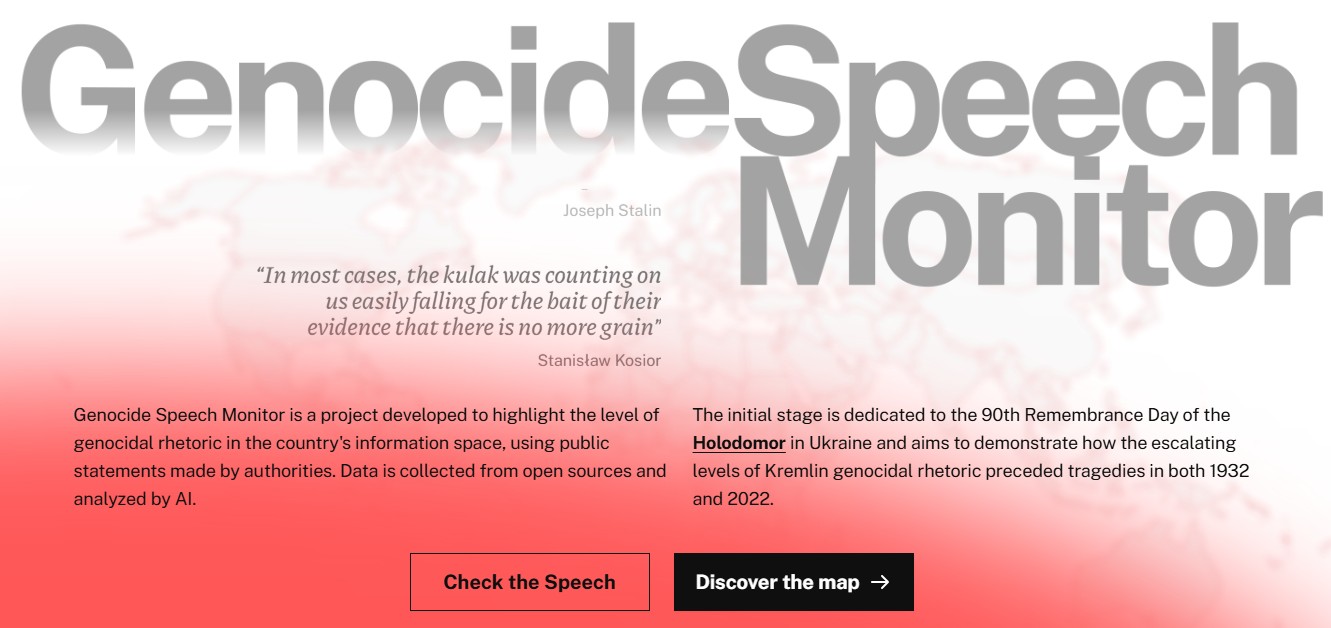
How do you tell the world about a tragedy that must never happen again? The Genocide Speech Monitor project combined the historical memory of the Holodomor with the current reality of war to highlight the dangers of genocidal rhetoric. Together with the Ukrainian Institute and Bickerstaff, we created a campaign that compelled the world to see and hear how words can turn into weapons.

Case study: Genocide Speech Monitor’s advertising campaign
Case study: Genocide Speech Monitor’s advertising campaign Case study: Genocide Speech Monitor’s advertising campaign Case study: Genocide Speech Monitor’s advertising campaign Case study: Genocide Speech Monitor’s advertising campaign Case study: Genocide Speech Monitor’s advertising campaign Case study: Genocide Speech Monitor’s advertising campaign Case study: Genocide Speech Monitor’s advertising campaign Case study: Genocide Speech Monitor’s advertising campaign Case study: Genocide Speech Monitor’s advertising campaign
Genocide Speech Monitor’s Advertising Campaign – Raising Global Awareness of Genocidal Rhetoric
This story begins with memory…
Ninety years ago, the Holodomor became a wound that remained in the heart of every Ukrainian. It was not just a crime but a deliberate policy of destruction. The artificial famine created by the Soviet government killed millions of people, leaving Ukraine bleeding. The Holodomor became one of the most brutal crimes against humanity in history, an example of genocide that not only destroyed lives but also tried to erase the nation as such.
Today, Ukraine is once again at the center of global attention. The full-scale war unleashed by russia in 2022 has shown that the aggressor’s goal is not just to seize land but to eradicate the Ukrainian nation. The rhetoric of hatred that the aggressor country has voiced for years has been embodied in mass crimes: bombing of cities, torture of civilians, deportation of children, and cultural genocide. This war continues the same policies that once led to the Holodomor.
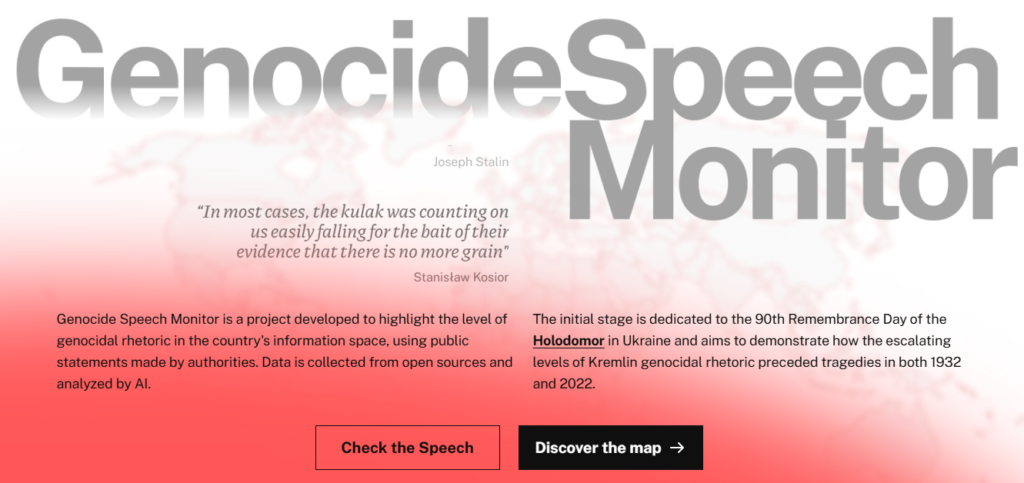
When Bickerstaff and the Ukrainian Institute offered us to join them in spreading the word about the tragedy of the Ukrainian people, we realized that this was more than a marketing campaign. It was an opportunity to tell the world about the terrible lessons of history that we cannot allow to be repeated. Together, we launched the Genocide Speech Monitor campaign to remind the world of these lessons and emphasize the danger posed by hate speech. Genocide Speech Monitor is a project designed to highlight the level of genocidal rhetoric in the country’s information space, using public statements by government officials as an example.
The challenge: How do we talk about pain?
The development of this campaign was complex. The topic of genocide, both historical and contemporary, is painful and difficult for international audiences to understand. In addition, political advertising and campaigns on socially significant issues are often blocked on popular platforms.
How should this topic be conveyed to people in 41 countries, including the United States, Canada, Europe, and Latin America? How can millions of people in different cultures be made to feel an emotional connection? The answers to these questions determined our strategy.
The solution: tell a story that resonates
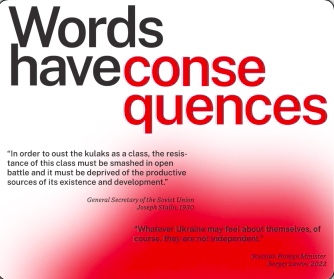
We decided to create a campaign that uses the parallels between the historical events of the Holodomor and modern warfare.
 In the first stage, our partners developed a system that analyzes politicians’ public speeches. Genocide Speech Monitor collects public speeches of public officials from open sources and analyzes them using artificial intelligence. The purpose of the analysis is to search for signs of genocidal rhetoric provided by genocide researchers.The initial stage was dedicated to the 90th anniversary of the Holodomor in Ukraine and aimed to demonstrate how the escalation of the Kremlin’s genocidal rhetoric preceded the tragedies in 1932 and 2022.The data collected in the Genocide Speech Monitor project became the basis for videos and banners that resonated with the audience. |
Popular social networks such as Facebook, Instagram, Twitter, or TikTok have several restrictions or do not allow advertising on social and political topics. To overcome these restrictions, we used Google Display Network and YouTube ads. We set up appropriate targeting of the target audience to reach the maximum number of people quickly. We must communicate with an audience that is socially and politically active because these are the people who have the most significant influence on the public opinion of the partner countries.
In addition, we used the campaign website speech-monitor.ui.org.ua, where users could learn more about the topic and interact with the analysis system.
Thanks to well-thought-out creatives and optimized advertising, we achieved high results. The video campaign demonstrated high audience engagement, with 45% of viewers watching the video. This is almost twice as high as the standard for similar campaigns (an average of 25%).
Results: words have power
The campaign brought great results:
▪️ 6.7 million unique users in 41 countries saw our communication.
▪️ 316,016 video impressions, of which 45% of the audience watched the video to the end (well above the standard of 25%).
▪️ thanks to this, the video received 143,079 total views on YouTube, 43% more than the planned figure.
▪️ During the campaign, we received 12.1 million banner impressions on the Google Display Network.
▪️ and 12,444 visits to the campaign website from people who wanted to learn more about the topic and find out more about the campaign.
The campaign must reach audiences in the United States and Western Europe, regions where knowledge of the genocide in Ukraine is crucial for international support. The high engagement rates indicate that this story resonated with people from all over the world.
Conclusions: lessons to remember
The Genocide Speech Monitor campaign proved that even the most difficult topics can resonate with the right creative approach. Not only did we exceed our KPIs, but we also managed to draw attention to an important topic that had previously remained on the periphery of Westerners’ attention.
This project showed that words matter. The campaign has bridged history and modernity, evoking an emotional connection with worldwide audiences. We are proud to have been a part of this initiative and believe that Genocide Monitor will inspire others to speak up.
If you have a similar request, please contact us at partnership@inseed.marketing.
Learn more about our case studies.
Contact us Contact us Contact us Contact us Contact us Contact us Contact us Contact us Contact us

Thank you!
In the near future we will reply to your email.