

How we helped GLID App attract its first users
Comprehensive marketing support for the launch of the innovative digital health app GLID App: how we helped the startup to effectively enter the market, attract the first users, and test the strategy before scaling.

How we helped GLID App attract its first users
How we helped GLID App attract its first users How we helped GLID App attract its first users How we helped GLID App attract its first users How we helped GLID App attract its first users How we helped GLID App attract its first users How we helped GLID App attract its first users How we helped GLID App attract its first users How we helped GLID App attract its first users How we helped GLID App attract its first users
How We Helped GLID App Gain First Users
Introduction
GLID App is a mobile healthcare application that changes users’ approach from situational disease treatment to continuous health maintenance. Its mission is to make interacting with medical services simple, accessible, and understandable. However, creating an innovative product is only half the battle. It is also essential to convey its value to the target audience. That’s why the GLID App team contacted us for comprehensive marketing support.
The challenge
The GLID App was ready to launch, but how can we convey its value to people who could use it? The digital health market is competitive, and the audience’s attention is scattered among many services. GLID is designed for the private sector, so it was essential to attract the attention of those customers. Therefore, we had to answer several key questions:
▪️ How to effectively launch an app on the market and test demand?
▪️ How to attract the first users?
▪️ Which channels will give the maximum conversion?
▪️ How to build knowledge about the app?
The campaign was launched locally, in the Kriukivshina, where a network of partner institutions had already been established. This made it possible to test hypotheses and optimize the marketing strategy before scaling to the whole of Ukraine.
Solution
We developed a comprehensive product promotion strategy that covered all the necessary stages.
Defining the target audience
As a first step, we analyzed the target audience. It turned out that there are three key segments of the target audience that Glid needs to work with:
1. Core users (B2C) are young residents of Kyiv, primarily women, who are already actively caring for their or their family’s and children’s health. Their primary need in this category is to monitor the health of children and the whole family.
2. Users are followers (B2C). The wider audience consists of residents of large cities who respond to medical problems only in critical situations. They need to solve health problems quickly and easily if necessary.
3. Partners (B2B). Representatives of medical institutions (B2B partners) looking for ways to improve customer experience and engagement to improve business performance.
Designing the customer journey
The next step was to plan the Customer Decision Journey in detail. This tool helps us identify the main stages of a customer’s decision-making, their needs at each stage, and the tools we should use to communicate with them. This included three main stages:
▪️ demand creation,
▪️ demand conversion, and
▪️ the loyalty cycle.
We defined tools, messages, and key performance indicators (KPIs) for each CDJ stage, allowing Glid to plan all subsequent marketing activities systematically.
Formation of a communication ecosystem
Based on CDJ, we have built a comprehensive communication ecosystem that covers all the necessary promotion channels and ensures the fulfillment of all communication tasks:
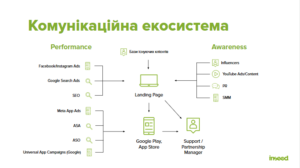
Communication plan
Based on the CDJ and the communication ecosystem, we developed a communication plan for the year, which included:
▪️ digitization of the target audience – the volume of the target audience and determination of targeting parameters
▪️ calendar plan – a calendar timeline of activities for the year
▪️ SMM plan – content policy and content calendar
▪️ Email outreach – approach to mailings
▪️ PR – definition of target audience segments and examples of relevant platforms
▪️ SEO – expanding the content base, internal and external optimization
▪️ Pilot campaign plan – setting goals, KPIs, and calculating a media plan.
Dmitry Kudinov, founder and CEO of inseed.agency
“Before launching a startup, the most unpredictable and controversial metric is often the customer acquisition cost (CAC). Since the viability of the entire business model largely depends on it, funders try to predict it in advance. But this is difficult to do if you are launching a product in a new category, or there is not enough data or benchmarks for your market segment. That’s why we help our clients calculate this cost based on additional indicators such as the cost of driving traffic from certain channels for a certain target audience, average conversion rate, etc. This allows us to accurately predict the cost of acquisition and evaluate the overall effectiveness of the business model.”
Strategy implementation
Website development
With our partners at Whileweb Production, we developed a Glid website that communicated Glid’s key functionality and value. To measure the effectiveness of the site, we set up
▪️ Google Analytics 4
▪️ Microsoft Clarity
Setting up application analytics
Before implementing the strategy, we set up an analytics tracking system in the GLID App (Google Analytics for Firebase) to analyze user behavior and identify possible points for improving conversion. Key indicators we monitored:
▪️ Percentage of users who completed registration.
▪️ Number of active users in the first 7 days after installation.
▪️ Popular app features and their usage.
Pilot advertising campaign
At this stage, we focused on attracting the first users and testing to determine the most effective channels and test hypotheses on the cost of customer acquisition (CCA):
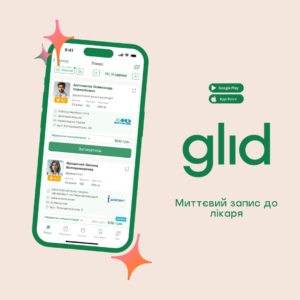
▪️ Launch of Google Universal App Campaigns and Meta App Ads to attract the first users.
▪️ Promotion through social media, targeted advertising, and posts on Facebook and Instagram.







Results
The pilot campaign in Kriukivshchyna showed promising results:
▪️ The conversion rate from installation to registration was 90%, which exceeded our expectations.
▪️ 65% of users actively used the doctor search function after registration, which confirmed our hypothesis that the audience was interested in the app’s functionality.
After receiving the first results, the Glid team expanded the app’s functionality, taking into account user feedback. This allowed us to increase GLID’s value for the audience and strengthen our market position.
Conclusions
Despite the limited geography, we exceeded expectations in key metrics and confirmed the cost of customer acquisition (CCA) hypothesis. The high conversion rate from installations to registrations confirmed the effectiveness of our funnel. We gained valuable insights for future scaling:
▪️ Meta App Ads needs to be scaled up due to limited reach during the pilot, so we recommended retesting with a broader audience.
▪️ The website has the potential for organic growth. Its high conversion rate to the App Store confirms its effectiveness in attracting users.
▪️ User activity in the app is high, which signals further work on user retention and re-engagement.
Thus, a phased approach allowed us to successfully launch the GLID App and create a clear plan for further scaling, which proved effective at the campaign’s first stage. We built a solid foundation for scaling the project thanks to competent media planning, hypothesis testing, and an effective digital strategy. New challenges and even better results are ahead!
Check out more of our projects here.
If you have a similar request, write to us at partnership@inseed.marketing and we will help you implement your project.
Contact us Contact us Contact us Contact us Contact us Contact us Contact us Contact us Contact us

Thank you!
In the near future we will reply to your email.